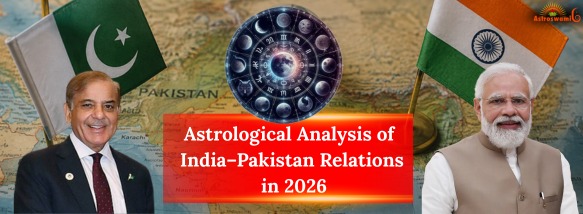
Astrological Analysis of India–Pakistan Relations in 2026

The India–Pakistan relationship in 2026 is not merely a political or diplomatic equation; in Vedic astrology, it is shaped by the birth‑horoscopes of both nations, current planetary transits, and karmic patterns inherited from past wars and crises. 2026 stands out as a year of intense geopolitical tension, periodic escalation, and paradoxical opportunities for calibrated diplomacy, all of which are reflected in the planetary positions around India’s and Pakistan’s prashna/Chaitra‑Shukla‑Pratipada horoscopes.

This 2,500‑word analysis explores the astrological backdrop, key planetary triggers, war‑peace probabilities, economic‑security dimensions, and long‑term karmic implications for India–Pakistan relations during 2026.


How Astrology Views Nations: India and Pakistan’s Natal Charts

In Vedic astrology, nations are often read using their independence‑day or foundation‑day horoscopes (Chaitra‑Shukla‑Pratipada in the case of India and Pakistan). For India, the chart cast for 15 August 1947, 12:02 PM, New Delhi is widely used, with Libra (Tula) Lagna and Moon in Scorpio (Vrishchik). For Pakistan, the 14 August 1947, Karachi chart is taken, with an Aquarius (Kumbh) Lagna and Moon in Leo (Simha) in some traditional derivations.

India’s Chart: Scorpio Moon and Libra Lagna

  • Libra Lagna (ruled by Venus) gives India a natural inclination toward diplomacy, balance, and strategic alliances, but also to prolonged negotiations rather than quick resolutions.
  • Moon in Scorpio (ruled by Mars) adds intensity, secrecy, and emotional depth to security‑related issues, especially with Pakistan. This placement often correlates with covert operations, border‑tension surges, and internal‑security‑focused leadership.

 Pakistan’s Chart: Aquarius–Leo Dynamics

  • Aquarius Lagna (ruled by Saturn) indicates a country structurally prone to instability, power‑shifting, and military‑institutional dominance.
  • Moon in Leo (Sun‑ruled) reflects a national ego, pride, and sensitivity to perceived humiliation, making it politically difficult for any Pakistani government to appear “soft” on India.

These natal charts reveal that India tends to approach the relationship with strategic calculation, while Pakistan reacts with national‑pride‑driven emotional volatility, setting the stage for cycles of crisis.


Major Planetary Transits in 2026 That Shape India–Pakistan Ties

Several overlapping planetary movements in 2026 influence the security, political, and public‑mood environment along the India–Pakistan fault line. Key among them are Saturn’s transit into Aries, Jupiter’s movement through Gemini and Cancer, Mars’ fiery placements, and the Rahu–Ketu axis tipping from Pisces–Virgo into Aquarius–Leo.

Saturn in Aries and Its Impact

Saturn enters Aries in 2026, occupying the 1st house (Aries–Lagna) for many individual‑country variations and activating the 10th house of power, career, and public image for India’s Libra‑Lagna. This means:

  • Saturn in Aries intensifies military preparedness, border‑security rigor, and institutional accountability.
  • For India, the 10th‑house influence can trigger more assertive, if carefully calibrated, foreign‑policy moves toward Pakistan, especially around Kashmir and cross‑border terrorism.
  • For Pakistan, Saturn in a fiery sign can amplify internal pressure, leadership‑credibility challenges, and economic‑security stress, which often spill over into aggressive posturing vis‑à‑vis India.

Astrologers have noted that this Saturn‑in‑Aries phase often coincides with heightened militarization, border skirmishes, and “show‑of‑strength” phases along the Line of Control (LoC).

Jupiter in Gemini–Cancer: Diplomacy vs. Emotion

Jupiter, the planet of wisdom, expansion, and law, moves through Gemini and then Cancer in 2026. For India’s Libra‑Lagna, Gemini links to communication, intelligence, and strategic‑thinking houses, while Cancer connects to emotional security, public sentiment, and home‑front concerns.

This transit suggests:

  • More diplomatic channels, back‑channel talks, and “wisdom‑driven” decision‑making in India’s Pakistan‑policy, especially in early 2026.
  • As Jupiter enters Cancer, public‑mood and media‑driven nationalism gain strength, which can both constrain and enable hard‑line responses.
  • For Pakistan, Jupiter in this zone can create brief opportunities for dialogue and confidence‑building measures, but these are often undermined by Saturn‑driven military and intelligence‑establishment influence.

Mars, Rahu–Ketu, and the Risk of War

Mars, the planet of war, is strongly placed in India’s chart and in Scorpio‑type signs in 2026, amplifying military‑and‑security energy. Rahu (North Node) and Ketu (South Node) shifting into Aquarius–Leo can trigger unexpected crises, sudden escalations, and “hidden‑provocation” patterns such as covert attacks, proxy‑group surges, or border incidents that escalate quickly.

Many astro‑commentators have pointed out that:

  • Mars‑dominated years tend to see at least one Kargil‑like incident or major border crisis.
  • Rahu–Ketu axis changes often precede geopolitical shocks in the India–Pakistan region, especially around the LoC and western borders.

However, these energies do not guarantee full‑scale war; they indicate higher probability of localized conflict, surgical‑style responses, and tense‑stalemate phases rather than prolonged conventional warfare.


War vs. Peace: What the Stars Indicate for 2026

Astrologers are divided on whether 2026 will see full‑scale war or manageable crisis‑plus‑dialogue, but the planetary mix suggests an intermediate outcome: repeated spikes of tension, partial escalation, and limited‑surgical responses, with intermittent diplomatic windows squeezed by domestic‑political pressures.

Indicators Supporting Escalation and Conflict

Several astrological markers in 2026 increase the risk of serious India–Pakistan crises:

  • Mars‑dominated period: India’s current Mars‑Mahadasha (often dated from 2025–2032) is linked by some astro‑analysts to Kargil‑like incidents and border‑flare‑ups around the LoC.
  • Solar eclipse on 12 August 2026, conjunct sensitive points in India’s chart, has been flagged by some astro‑bloggers as a potential trigger for major crises, damage, or destruction‑level events, echoing similar patterns seen in prior war‑linked years.
  • Saturn in Aries combined with Mars‑type transits tends to produce military‑posturing, heightened patrol‑intensity, and rapid escalation if any trigger incident (terror attack, border‑crossing, etc.) occurs.

Some individual astrologers have even gone as far as predicting a possible India–Pakistan attack date around 21 March 2026, citing Angarak‑Yog formations, Rikta‑Tithi, and specific house‑conjunctions in that day’s composite chart, though such predictions remain speculative and have sparked controversy online.

Indicators Supporting Restraint and Calibrated Responses

Despite the war‑like energies, other planetary influences urge restraint:

  • Jupiter in Gemini–Cancer adds a wisdom‑and‑caution layer, encouraging diplomacy, legal‑channel‑based responses, and international‑pressure tools.
  • Saturn’s discipline in Aries can push both sides toward carefully controlled escalation brackets, avoiding full‑scale war but not ruling out limited strikes or counter‑strikes.
  • Public‑mood dynamics in India, with Jupiter‑influenced Cancer‑house themes, may favor national‑pride‑driven support for “strong” action, but also pressure for economic‑stability and peace in the long run.

Astrologically, this suggests that 2026 is more likely to see “crisis‑plus‑containment” than all‑out war, with the relationship oscillating between tense‑stalemate and short‑lived dialogue windows.


Economic and Security Dimensions of the 2026 Equation

Astrology does not just see India–Pakistan relations as security‑only variables; it also links planetary positions to economic stability, trade, energy, and infrastructure‑security. 2026’s transits point to a turbulent but manageable economic‑security picture along the border.

Trade, Infrastructure, and Energy

  • Saturn in Aries may push both countries to prioritize border‑infrastructure, fencing, surveillance, and cyber‑security over sustained trade‑normalization.
  • Jupiter in Gemini‑Cancer can create brief windows for corridor‑development, trade‑talks, or limited‑trade‑resumption, but Saturn’s restraining influence may keep these short‑lived and symbolic.

For India, the 2026 period may see continued focus on self‑reliance (Atmanirbhar Bharat‑type themes) in defence and critical‑sector goods, with reduced dependence on volatile Pakistan‑linked supply‑chains.

Internal Security and Public Mood

  • Mars‑and‑Rahu‑driven transits often correlate with heightened internal‑security alerts, terrorism‑related fears, and media‑driven paranoia.
  • For Pakistan, Saturn‑Aquarius‑type stress can amplify internal‑political‑tensions, military‑civis‑relations strains, and economic‑crisis narratives, all of which may be projected outward toward India as a unifying‑enemy‑narrative.

In both countries, 2026 may see security‑discourse dominating public‑mood, with political leaders leveraging national‑security themes for domestic‑consolidation.

Long‑Term Karmic Outlook: Beyond 2026

Astrologically, the India–Pakistan equation carries heavy karmic baggage from 1947, 1965, 1971, 1999 (Kargil), and 2019–2020 strikes. The 2026 transits must be read against this long‑cycle karma.

A Phase of Intense Karmic Reckoning

  • Saturn’s strong presence in 2026 aligns with karmic reckoning: past‑aggression, unresolved‑Kashmir‑tensions, and proxy‑war‑patterns being visited upon both sides in the form of crises, setbacks, or diplomatic‑strains.
  • For Pakistan, some Vedic‑style blogs describe 2026 as a “karmic‑reckoning” year, with Saturn‑Mars‑type intensities affecting border‑relations and internal‑stability.
  • For India, this can mean periods of national‑stress and moral‑dilemmas: balancing security‑needs, human‑rights, and global‑perception.

Gradual Shifts in Power Dynamics

Astro‑commentators note that Mars‑dominated periods (until 2032) may tilt India–Pakistan power‑dynamics further toward India’s strategic‑advantage, with stronger military, economic, and diplomatic leverage.

  • Pakistan’s Saturn‑and‑Aquarius‑weighted chart may force it into repeated‑institutional‑and‑economic‑rebalancing, limiting its capacity for sustained aggression.
  • India, with Jupiter‑and‑Saturn‑support, can gradually build regional‑security‑architecture and multi‑aligned‑alliance‑networks, reducing Pakistan’s ability to isolate India diplomatically.

This suggests a long‑term trend of India gaining strategic‑ascent, while Pakistan grapples with internal‑and‑regional‑pressures, even if 2026 itself remains volatile.


Astro‑Informed Policy Suggestions: Reading the Stars Pragmatically

Astrology does not replace geopolitics, but it can offer thematic guidance for policymakers and citizens. Based on the 2026 transits, several astro‑aligned suggestions emerge:

 For India’s Leadership

  • Use Jupiter‑in‑Gemini‑Cancer phase for back‑channel diplomacy, crisis‑containment‑mechanisms, and long‑term security‑strategy‑refinement.
  • Avoid over‑reliance on Mars‑style‑surgical‑responses; let Saturn‑Aries‑discipline ensure measured, proportional, and internationally‑defensible actions.
  • Prepare for August 2026‑type eclipse‑linked crisis‑windows with heightened security‑alert levels and contingency‑planning, without inciting panic.

 For Pakistan’s Actors

  • Recognize Saturn‑Aquarius‑influenced internal‑stability‑needs and economic‑constraints; avoid escalations that further strain domestic‑capacity.
  • Capitalize on Jupiter‑in‑Cancer‑type windows for limited‑dialogue or confidence‑building‑measures with India, even if framed as “tactical‑thaws.”

 For Citizens and Media

  • Avoid astro‑doom‑mongering (e.g., fixed‑war‑dates without evidence), but heed themes of heightened‑security‑awareness, preparedness, and resilience.
  • Support policies that emphasize economic‑stability, social‑cohesion, and crisis‑management, aligning with Saturn‑discipline rather than Mars‑panic.


Conclusion: A Year of Tense Calm and Calibrated Conflict

Astrologically, 2026 does not indicate a guaranteed India–Pakistan war, but it does point to a high‑risk, high‑tension environment with elevated probabilities of border‑crises, localized‑escalations, and limited‑surgical‑responses. Saturn in Aries, Mars‑dominated energies, and Rahu–Ketu‑shifts create a backdrop where crises can erupt suddenly, but Jupiter’s presence in Gemini–Cancer offers countervailing guidance toward restraint, diplomacy, and calibrated‑power.


Related Articles


Recently Added Articles


Get Free Quote!

Submit details and our representative will get back to you shortly.

No Spam Communication. 100% Confidentiality!!